

SmFeN opens up new possibilities for drone motors when the magnetic material, rotor and manufacturing process are designed together. At the high-speed, low-torque operating point investigated, our simulations show mechanical output comparable to the NdFeB version. Injection-moulded ring magnets enable tailored magnetisation and the integration of mechanical functions. Combined with qualified supply chains, this creates additional options for performance, assembly and sourcing. Max Baermann supports development from the material to the magnetised and tested component. [1, 3]
Autor: C. Wiehe, Head of Supply Chain & Quality Management | 2. November 2026

Why alternative rotor concepts are becoming more important
China’s Announcement No. 49/2026, published on 19 October 2026, provides for revised export controls on selected drone components and technologies from 18 November 2026. It covers clearly defined products and is not a general export ban on drone motors.
For product development, this is another reason to consider material availability and component sourcing early. We therefore assess the magnetic material, rotor architecture and manufacturing process together.
In drone drives, the magnetic material, available space and operating range need to work together. Polymer-bonded SmFeN allows us to design the magnetic solution specifically for these requirements. Alongside the material’s magnetic properties, we develop geometry, magnetisation and manufacturing as an integrated solution. This enables our customers to combine the required motor output with a design that simplifies assembly.
Using injection moulding, we process a compound of magnetic powder and a thermoplastic binder into application-specific components, such as closed, multipole ring magnets. Geometry and pole pitch can be matched to the available space and the motor’s magnetic design. [2, 3]
1. Performance matched to the drone motor’s operating point
Our simulations of a small camera drone motor confirm that, at low torque, the SmFeN version achieves higher speeds than the NdFeB version used for comparison. We used a remanence of 0.8 T for injection-moulded SmFeN and 1.4 T for sintered neodymium iron boron, or NdFeB, in the calculations. Remanence describes the magnetic flux density remaining in the material after magnetisation. [1]
At the high-speed, low-torque operating point investigated, the motor with SmFeN magnets achieves mechanical output comparable to the motor with sintered NdFeB magnets. SmFeN is therefore well suited to delivering the output required at this point. At higher torque, the NdFeB version offers greater power reserves. When selecting a magnetic solution, we therefore consider the application’s full speed and torque profile alongside remanence. [1]

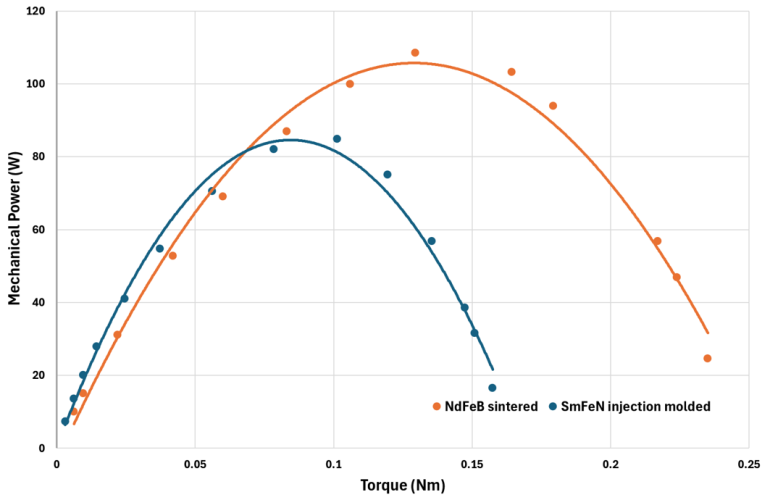
At the same torque, the SmFeN version we simulated requires higher currents than the NdFeB version. We therefore match the magnet, winding, power electronics and thermal behaviour together. A suitable drive solution must deliver the required mechanical output within its electrical and thermal limits. Claims about efficiency or longer flight time require an assessment of the complete drive system. [1]

2. Integration through ring geometry and insert moulding
With injection-moulded SmFeN ring magnets, we combine application-specific magnetic design with component geometry that simplifies assembly. A ring brings multiple magnetic poles together in one component. In our simulations, arc-shaped magnetisation delivers higher maximum torque and a higher torque constant at low speeds than uniformly magnetised segments made from the same material. [1]

Insert moulding allows us to join the ring magnet directly to a functional component: a prefabricated insert is positioned in the mould and overmoulded with the magnetic compound. This creates compact hybrid components that combine magnetic and mechanical functions. Direct injection moulding of multipole polymer-bonded magnets into soft magnetic rotor inserts has also been demonstrated experimentally using ferrite compounds. [3] For our customers, this process opens up additional motor design options and opportunities to reduce individual components and assembly operations. With a suitable connection between the insert and the magnetic compound, separate adhesive bonding processes can also be eliminated. [4] We jointly match ring geometry, magnetisation and the component connection to speed, temperature and mechanical loading.
One possible rotor concept mechanically interlocks a multipole SmFeN ring from our TROMANIT brand with a steel sleeve or a rotor bell made from a graphite and carbon-fibre polymer compound from our TROMACOMP brand through insert moulding. Mounting features and the propeller hub could be integrated directly into the rotor carrier.
The ring geometry replaces the positioning of individual magnet segments. Material orientation, forming and the magnetisation tooling determine the field distribution. Pole pitch, magnetisation, air gap and magnetic back iron are designed together; concepts with reduced back iron or without back iron are also conceivable.
Moulded cooling surfaces and targeted heat paths could complement mechanical integration with thermal management functions. TROMACOMP provides a material option for this purpose, without assuming better heat dissipation than a metal rotor bell.
3. Magnetic materials and additional supply chain options
SmFeN stands for samarium iron nitrogen. The magnetic phase contains samarium, a rare-earth element, but no neodymium or heavy rare earths. SmFeN therefore broadens the range of material options available to our customers. When selecting a specific compound, we consider its composition, magnetic properties and the component’s requirements. [2]
SmFeN also opens up additional opportunities in material sourcing. Samarium is currently mined and processed predominantly in China, but also occurs widely outside China. Economic factors leave many of these resources unused, offering potential for diversified supply chains. We already have supply chains for SmFeN materials that are independent of China. Further background is available in our news article “SmFeN – an alternative rare-earth material for injection-moulded permanent magnets”.
Your benefit: tailored solution from material to component
For our customers, SmFeN brings together several advantages: an alternative to sintered NdFeB at a suitable operating point, greater rotor design freedom and the ability to integrate magnetic and supporting functions into one compact component. This can eliminate individual parts, assembly operations and, with an appropriate design, adhesive bonding processes. Our established China-independent supply chains for SmFeN materials also provide additional sourcing options. By considering sourcing options during design, we help our customers technically assess alternative materials and manufacturing routes and qualify them for their applications.
We support this development from material selection and simulation through compounding, toolmaking and injection moulding to the magnetised and tested component. We have already built a drone motor prototype with injection-moulded SmFeN magnets. Together with our customers, we align the operating point, magnetisation and manufacturing process to develop an application-specific solution for series production. [1]
References
[1] Max Baermann GmbH, „De-risking Your Magnet Supply Chain – Bonded SmFeN as an alternative to sintered NdFeB in brushless motors“
[2] Tetsuji Saito: Progress and Prospect of Sm-Fe-N Magnets. Inorganics 13(10), 322, 2025. Autor: Chiba Institute of Technology.
[3] Uta Rösel und Dietmar Drummer: Injection Moulding of Multipolar Polymer-Bonded Magnets into Soft Magnetic Inserts for Rotors in Reluctance Motors. Magnetism 1, 3–21, 2021.
[4] David Drexler et al.: Advances in electric motors: a review and benchmarking of product design and manufacturing technologies. e+i Elektrotechnik und Informationstechnik 142, 312–345, 2025.