

Changing a magnet material or supplier during series production can require costly, time-consuming validation tests and approvals. Risk management and a supply chain strategy should therefore be part of product development from the start. This includes supply chains and production strategies tailored to each market. We help design products with alternatives in place early, reducing repeat testing and the work needed when supplies are disrupted.
Author: C. Wiehe, Head of Supply Chain & Quality Management | 9. November 2026

Losing track of trade restrictions and their implications for your supply chain?
We keep you up to date on relevant trade restrictions and explain what they mean for permanent magnets. For globally connected mechatronic systems, supply chain resilience is an important part of risk management. This can quickly become complex when magnets, sensors, semiconductors and their raw materials are involved.
China’s Announcement No. 49/2026 of 19 October 2026 illustrates how trade restrictions can also extend to finished components. It provides for revised export controls on selected drones, propulsion components and technologies from 18 November 2026. These include specified brushless motors and electronic speed controllers. The controls apply to defined categories and do not constitute a blanket export ban on Chinese drone components. [28]
Requirements affecting magnetic materials and their precursors must be assessed separately from control entries for finished motors. For manufacturers, this means considering material availability, component sourcing and regional production options together during product development and assessing suitable alternatives at an early stage.
Once a product is in series production, changing a material or supplier can trigger new tests, customer approvals and extensive coordination between engineering, quality, purchasing and production. Under time pressure, this can delay a response to supply disruptions.
Max Baermann helps build alternatives into product development from the start. We coordinate the magnetic material, magnetisation, sensor and air gap, and develop and validate suitable solutions with our customers. At the same time, we can develop resilient supply chain strategies tailored to each market. In suitable applications, this can enable alternatives to neodymium magnets. The goal is to use the same system design in Asia, Europe and North America, with materials and supply chains adapted to each region.
We can validate these options during product and process development to help avoid lengthy, costly repeat tests and approval procedures. This reduces later development effort and makes changes faster and easier to coordinate.
1. Check which restrictions apply to your magnets
The table lists measures affecting permanent magnets, their production and technical compounds. Active and suspended measures are marked separately. Status as of 6 November 2026.
Under Announcement No. 70/2025, China initially suspended the additional export controls on rare earths until 10 November 2026. On 28 September 2026, MOFCOM confirmed the extension of the overarching Kuala Lumpur arrangement until 10 January 2027. On this basis, the table below treats the suspension of the affected announcements as extending to 10 January 2027. The basis is Section VIII of the MOFCOM statement on the eighth round of trade consultations; the wording of Announcement No. 70/2025 originally specifies 10 November 2026. [12, 13]
Chinese export control announcements at a glance
Die Tabelle enthält Maßnahmen zu Permanentmagneten, ihrer Herstellung und technischen Compounds. Geltende und ausgesetzte Maßnahmen sind getrennt gekennzeichnet. Stand: 6. November 2026.
China hat die zusätzlichen Exportkontrollen mit der Bekanntmachung 70/2025 für Seltene Erden zunächst bis zum 10. November 2026 ausgesetzt.
MOFCOM hat am 28. September 2026 die Verlängerung der übergeordneten Kuala-Lumpur-Vereinbarung bis zum 10. Januar 2027 bestätigt. Auf dieser Grundlage wird die Aussetzung der betroffenen Bekanntmachungen in der folgenden Tabelle bis zum 10. Januar 2027 eingeordnet. Grundlage ist die MOFCOM-Mitteilung zur achten Runde der Handelsgespräche, Abschnitt VIII; der Wortlaut der Bekanntmachung 70/2025 nennt ursprünglich den 10. November 2026. [12, 13]
| Announcement | Issued | Affected items and selected Chinese customs codes | Relevance to magnets and materials | Effective date and status |
| 18/2025 [2] | 4 Apr 2025 | Sm, Gd, Tb, Dy, Lu, Sc and Y items. Examples: Sm metal 2805301910. Dy metal 2805301200. Tb metal 2805301300. Control codes 1C902 to 1C908. | Sm: base element of SmCo and SmFeN. Dy/Tb: additions for improved NdFeB demagnetisation resistance at elevated temperatures. [21, 22] Gd: possible NdFeB addition. Partial Sm substitution in temperature compensated SmCo, with reduced room temperature remanence. [23, 24] |
In force from 4 Apr 2025. Not suspended by No. 70/2025. |
| 56/2025 [14] | 9 Oct 2025 | Specified rare earth processing equipment, ores and auxiliary materials. Codes 2B902, 1C914. Examples: ores 25309020. Specified vacuum induction strip casting furnaces 85142000. | Upstream powder and magnet production capacity, equipment and inputs. | Originally 8 November 2025. Suspended until 10 January 2027 on the basis of the extended Kuala Lumpur arrangement (MOFCOM statement of 28 September 2026, Section VIII). [12, 13] |
| 57/2025 [15] | 9 Oct 2025 | Ho, Er, Tm, Eu and Yb items. Codes 1C909 to 1C913. Listed metals: 28053019. | The announcement includes Ho containing permanent magnets and powders. Ho pole pieces can concentrate and direct magnetic fields. This component function is distinct from use as an alloying addition in NdFeB. [15, 25] | Originally 8 November 2025. Suspended until 10 January 2027 on the basis of the extended Kuala Lumpur arrangement (MOFCOM statement of 28 September 2026, Section VIII). [12, 13] |
| 61/2025 [16] | 9 Oct 2025 | Specified overseas rare earth items linked to Chinese inputs or technology. Scope defined by Annex 1, not one customs code. | Potential licensing obligations beyond direct exports from China. Includes a 0.1% value test for specified Chinese origin content. | Originally 9 October or 1 December 2025, depending on the provision. Suspended until 10 January 2027 on the basis of the extended Kuala Lumpur arrangement (MOFCOM statement of 28 September 2026, Section VIII). [12, 13] |
| 62/2025 [17] | 9 Oct 2025 | Rare earth mining, separation, metallurgy, magnet manufacture and recycling technologies. Codes 1E902.a/b. No goods tariff code. | Technical information, production support and technology transfer. | Originally 9 October 2025. Suspended until 10 January 2027 on the basis of the extended Kuala Lumpur arrangement (MOFCOM statement of 28 September 2026, Section VIII). [12, 13] |
| 39/2023 [18] | 20 Oct 2023 | Natural flake graphite and products, e.g. 2504101000 / 2504109100. Qualifying artificial graphite, e.g. 3801100030. | Relevant to graphite feedstocks for technical compounds, rather than permanent magnet chemistry. | In force from 1 Dec 2023. Not suspended by No. 70/2025. |
| 10/2025 [19] |
4 Feb 2025 | Specified W, Te, Bi, Mo and In items. Selected W inputs: ammonium paratungstate 2841801000. Tungsten carbide 2849902000. | Tungsten carbide fillers and selected upstream inputs. Not a general control on all tungsten containing products. | In force from 4 Feb 2025. Not suspended by No. 70/2025. |
| 58/2025 [20] | 9 Oct 2025 | Specified lithium batteries, artificial graphite anode materials, equipment and technology. Product specific scope. | Adjacent raw material measure. Not a blanket rule for graphite filled engineering plastics. | Originally 8 November 2025. Suspended until 10 January 2027 on the basis of the extended Kuala Lumpur arrangement (MOFCOM statement of 28 September 2026, Section VIII). [12, 13] |
| 70/2025 [12] | 7 Nov 2025 | Suspends Nos. 55, 56, 57, 58, 61 and 62/2025. No additional material or tariff code. | Pauses the October 2025 package. Leaves the April rare earth controls in place. | Effective since 7 November 2025. Original suspension until 10 November 2026; treated here as extending to 10 January 2027 on the basis of the extended Kuala Lumpur arrangement (MOFCOM statement of 28 September 2026, Section VIII). [12, 13] |
Additional US restrictions relevant to permanent magnets
The US measures below cover additional import duties and sourcing restrictions for defence contracts. Status: 6 November 2026, including DFARS requirements from 1 January 2027.
Ownership must also be checked where US sanctions apply. Under the US 50 Percent Rule, a company is also blocked if blocked persons together own at least 50% of it, directly or indirectly. This applies even if the company itself is not listed. Chinese ownership alone does not trigger the rule. [6]
| Announcement | Issued / version | Affected items and tariff references | Concrete restriction | Effective scope at review date |
| USA DFARS 252.225-7052 [4] |
30 May 2024 | SmCo and NdFeB magnets in covered US Department of Defense contracts and relevant subcontracts. Scope is material based, not defined by a tariff code. | Restrictions on covered materials from China, Russia, Iran or North Korea: melting and production until the end of 2026; additionally mining, refining and separation from 1 January 2027. End items manufactured in those countries containing covered materials are also covered. | Until 31 December 2026: alloy melting and subsequent production steps, including powder formation, sintering or bonding, and magnetisation. From 1 January 2027: the entire supply chain through the finished magnet; for SmCo, from mining or production of cobalt and samarium ores or feedstock, including recycled material; for NdFeB, from mining neodymium, iron and boron. Exceptions under paragraph (c) apply. From 2027, the COTS exception does not cover items containing at least 50% covered materials by weight. A specific exception applies to recycled NdFeB magnets if milling of the recycled material and sintering of the finished magnet take place in the US. [4] |
| USA Section 301 additional duty [5] |
Final notice: 18 Sep 2024 | Chinese origin metallic permanent magnets and articles intended to become magnets after magnetisation. US HTSUS 8505.11.00, including relevant NdFeB and SmCo products. | 25% additional import duty under Section 301, subject to applicable exclusions. | Applies from 1 Jan 2026. Origin and tariff classification are decisive. Shipping country alone does not determine origin. |
2. Trace dependencies beyond the magnet supplier
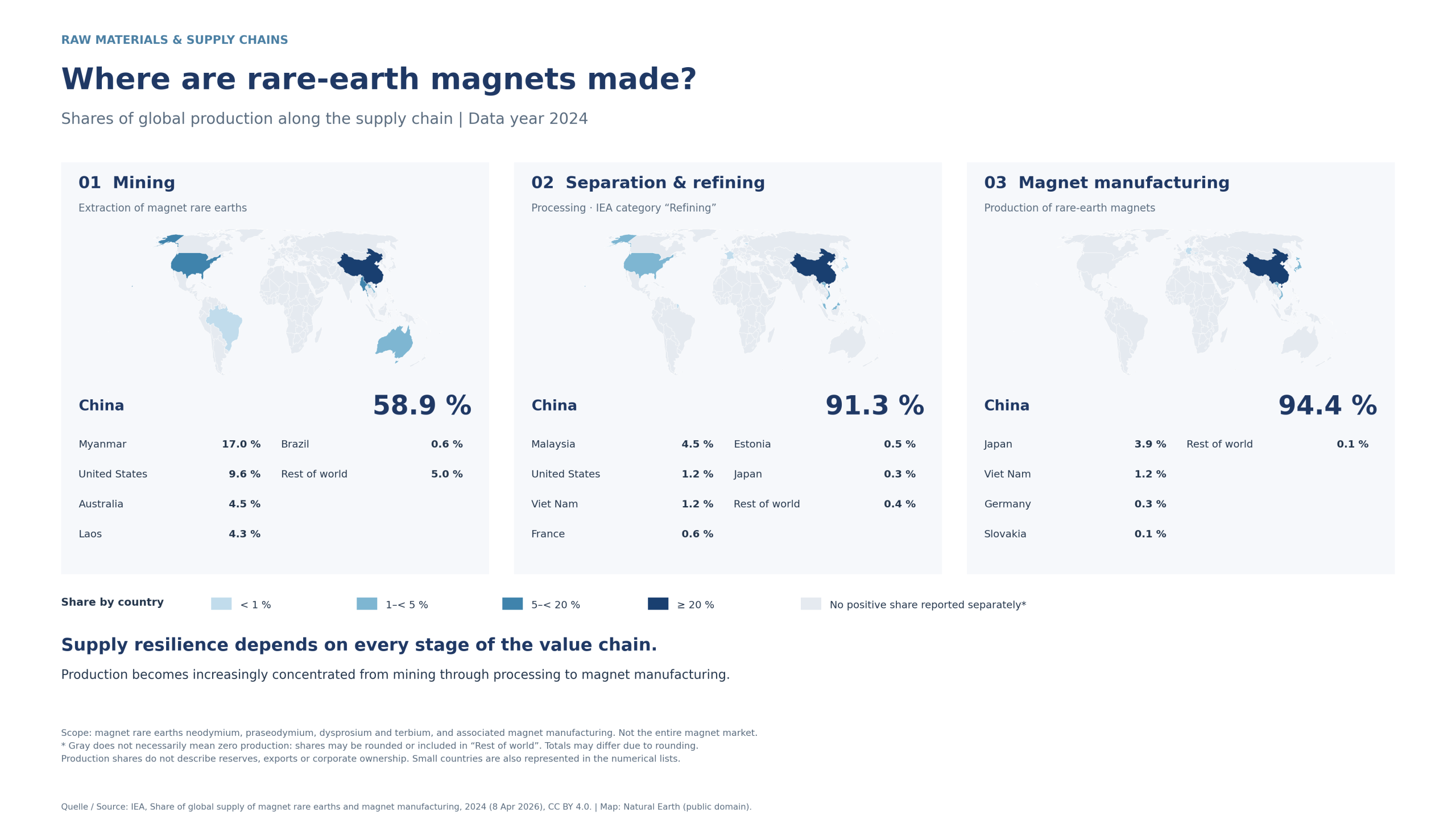
A magnet made in Europe or North America may rely on the same sources for mining, separation or powder as a magnet made in Asia. A regional supplier therefore does not necessarily reduce dependence on those sources. To avoid such dependencies, it is important to consider the entire system early in development. The map shows each region’s share at the different production stages. [1, 10]
3. Design the magnet and sensor for material alternatives
For sensor magnets, the interaction between magnet and sensor is particularly important. Magnetisation accuracy, pole pattern, geometry and the air gap affect the signal and measurement accuracy. Sensor technology and assembly tolerances also matter.
For rotor magnets, the available space and the wound armature are particularly important.
Adjusting these parameters can make SmFeN or ferrite suitable alternatives for some applications that currently use neodymium magnets. Replacing the magnet alone is usually not enough; the entire system should be considered from the start.
Simulations, sample measurements and rapid prototyping help identify suitable material alternatives, which can then be validated under the specified operating conditions.
The diagram below helps compare the different material types.
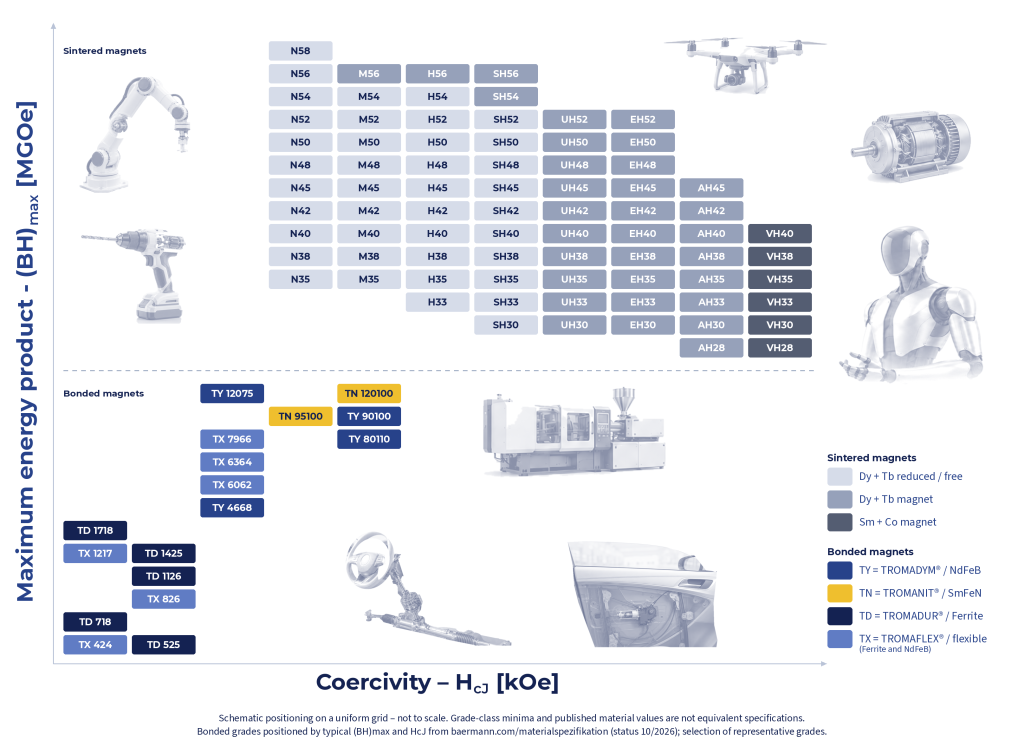
To reduce supply risks and improve flexibility, solutions that meet the same system requirements using adapted materials and supply chains should be considered and validated during product development.
Your benefit: prepare supply alternatives with Max Baermann
Max Baermann develops magnetic materials and components for your application. Our work includes magnetic simulation, compounding, toolmaking, injection moulding, magnetisation and measurement. We use these capabilities to assess material alternatives with your team and check how they perform in the system.
During the project, we can develop and validate solutions with supply chains tailored to each market. For Asia, Europe and North America, we assess which materials and manufacturing processes meet the required system performance. Within our production network, we can then manufacture in both China and Germany, using the supply chains qualified during the project to respond quickly to changes.
Quellen
[1] A. B. Stewart, MagComm, on behalf of the Magnetics Society. “RE-silience – Solutions for the RE Supply Situation”, MagNews #2, 2026.
[2] MOFCOM/GACC Announcement No. 18/2025, 4 April 2025.
[3] MOFCOM FAQ No. 5 on rare-earth-related items, 16 September 2025.
[4] DFARS 252.225-7052, Restriction on the Acquisition of Certain Magnets, Tantalum, and Tungsten. May 2024 clause, current and future provisions.
[5] USTR, final Section 301 modification notice, 89 FR 76581, 18 September 2024. HTSUS 8505.11.00, effective 1 January 2026.
[6] OFAC, Frequently Asked Questions 401, ownership and the 50 Percent Rule.
[7] US government, Supplemental Burma Business Advisory, 26 January 2024. rare earth elements and supply-chain due diligence.
[8] Reuters, Myanmar rebels disrupt China rare earth trade, sparking regional scramble, 28 March 2025.
[9] MOFCOM FAQ No. 3 on reference customs codes, 8 April 2025.
[10] IEA (2026), “Share of global supply of magnet rare earths and magnet manufacturing, 2024”, updated 8 April 2026. Data year: 2024. Licence: CC BY 4.0. https://www.iea.org/data-and-statistics/charts/share-of-global-supply-of-magnet-rare-earths-and-magnet-manufacturing-2024 Own visualisation. Base map: Natural Earth (public domain).
[11] Max Baermann, Material specifications for TROMADYM®, TROMANIT®, TROMADUR® and TROMAFLEX®. accessed 16 October 2026. https://www.baermann.com/materialspezifikation/
[12] MOFCOM/GACC Announcement No. 70/2025, 7 November 2025.
[13] MOFCOM interpretation of the eighth round of China–US talks, 28 September 2026, section 8. Offizielle Mitteilung, Abschnitt VIII
[14] MOFCOM/GACC Announcement No. 56/2025, 9 October 2025.
[15] MOFCOM/GACC Announcement No. 57/2025, 9 October 2025.
[16] MOFCOM Announcement No. 61/2025, 9 October 2025, including annexes.
[17] MOFCOM Announcement No. 62/2025, 9 October 2025.
[18] MOFCOM/GACC Announcement No. 39/2023, 20 October 2023.
[19] MOFCOM/GACC Announcement No. 10/2025, 4 February 2025.
[20] MOFCOM/GACC Announcement No. 58/2025, 9 October 2025.
[21] TRADIUM, Dysprosium: applications in magnetic alloys.
[22] TRADIUM, Terbium: applications in NdFeB permanent magnets.
[23] TRADIUM, Gadolinium: possible addition to NdFeB permanent magnets.
[24] How to Select the Appropriate Permanent Magnet Material. Gd substitution in SmCo.
[25] TRADIUM, Holmium: pole pieces for permanent-magnet systems.
[26] Energy Fuels, Q1 2026 results, 6 May 2026. Donald Project resources and separation development.
[27] Lynas Rare Earths, quarterly report for the period ended 31 March 2026, 21 April 2026.
[28] Chinese Announcement No. 49/2026, 19. Oktobre 2026.