

Injection-molded permanent magnets are characterized by complex inherent polarization structures. Neural networks trained with databases of analytically calculated fields enable a rapid determination of these parameter distributions after simple, time- and cost-efficient Hall sensor measurements – without lengthy numerical simulation steps. This provides a viable model of what happens inside the magnet and supports a realistic design of sensor and motor applications.
Author: T. Schliesch, Head of Research & Development | 22 October 2026

The challenge: complex inherent polarization structures
Injection-molded permanent magnets are characterized by complex inherent polarization structures that provide significant advantages in the generation of innovative magnetic field distributions for both sensor and motor applications. However, a more detailed understanding of these distributions is required to realistically design corresponding application systems.
The associated challenges concern, on the one hand, the interaction between magnet manufacturers and magnet users, since the magnet users are often unable to correctly simulate or design their application system due to software incompatibilities between the two parties. On the other hand, the complexity of inherent parameters can also affect the magnet manufacturer itself, as obtaining precise knowledge of such structures often requires elaborate multi-stage simulations followed by extensive evaluations.
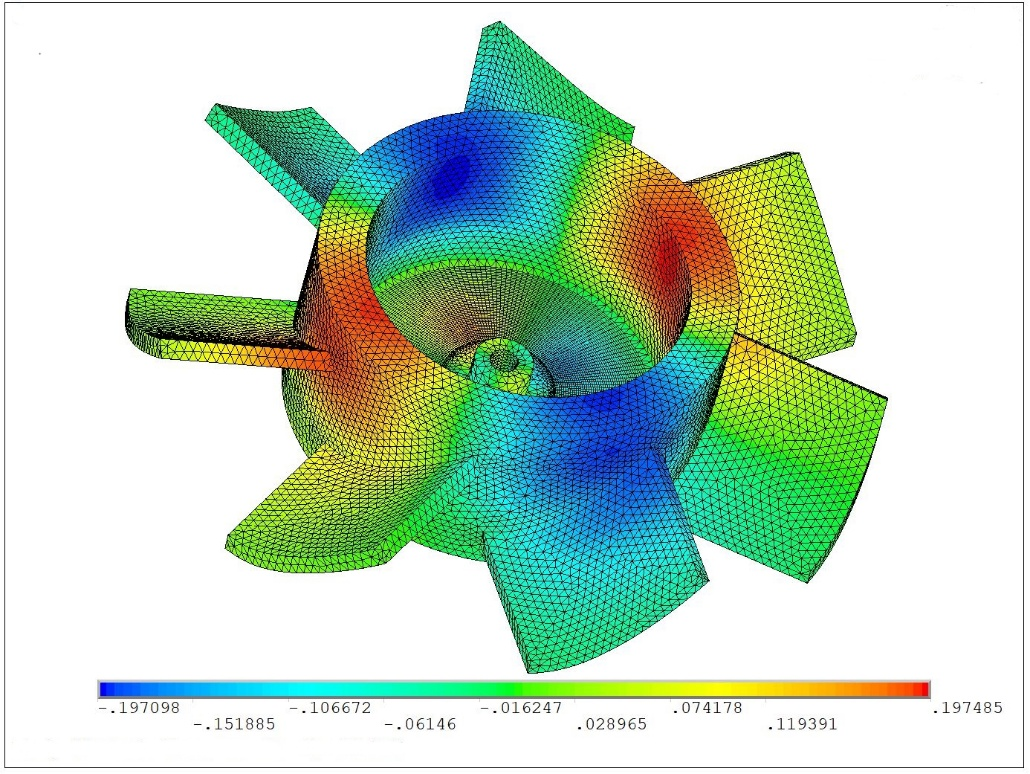
The approach: neural networks trained on physics-based data
The idea behind using AI is to establish corresponding databases containing the most important parameter distributions typical for injection-molded magnets, as well as the resulting external magnetic fields derived through analytical calculations. These databases are then used to train customized neural networks that incorporate the wide variety of resulting external field patterns and enable rapid determination of the respective parameter distribution after simple, time- and cost-efficient Hall sensor measurements.
This article is neither concerned with the use of LLMs like ChatGPT for getting general information about permanent magnets, nor with the use of AI for programming software or the development of new magnetic materials on the atomic or mesoscopic scale, where quantum effects still have to be considered. It is meant to tackle a few problems with real-life injection molded magnets, and the methods can also be applied to other specimens, as long as we are dealing with complex inherent distributions of magnetic polarization.
1. Physics-based training data: analytical field calculation
If magnetization is rigid or nearly rigid, the solution of Poisson’s equation via the following general solution for the resulting H field can be used to calculate fields outside or inside a permanent magnet:

The parameter distributions inside a magnet can be described by equations for the vector components of magnetization, comprising different characteristic parameters to be derived by neural networks. As an example, the following provides a model for the three vector components of magnetization of an alternatingly magnetized cylinder at its outer circumference in cylinder coordinates:

Mr0 is the remanence magnetization being directly proportional to the remanent flux density. The parameter dcr is related to the decay of magnetization from full saturation at the cylinder’s outer circumference to the inside of the specimen. The parameter A determines the shape of poles inside the magnet, where A = 1 describes a perfectly sinusoidal magnetization (often called Halbach magnetization). With increasing A, the shape becomes more and more trapezoidal with respect to the radial component of the polarization vector.
Parameter |
Meaning |
Influence on the magnetization |
| Mr0 | Remanence magnetization | Directly proportional to the remanent flux density |
| dc | Decay parameter | Decay of magnetization from full saturation at the outer circumference to the inside of the magnet |
| A | Pole shape parameter | A = 1: perfectly sinusoidal (Halbach) magnetization; with increasing A, increasingly trapezoidal radial component |
Table 1: Inherent magnetization parameters of an alternatingly magnetized cylinder, derived by the neural network.
2. Fast evaluation: from field measurement to inherent parameters
By calculating a multitude of fields with random variation of those 3 parameters, a dataset will be harvested, comprising radial H values on several thousand paths around the magnet at a fixed distance. Training a neural network with the 3 outputs as mentioned above will make up a so-called data model, which can be used to evaluate these 3 parameters on real-world magnets. A simple circumferential field measurement, fed into the trained neural network, will provide the inherent distribution of the 3 parameters and thus a viable model of what happens inside the magnet. And that without lengthy and time-consuming numerical simulation steps comprising the magnetizing device, hysteresis models, calculation of the final magnet and a final investigation of what happens inside and how it can be described.

3. Validated on a real magnet: repeatable results
Fig. 3 shows a result on a four-pole magnet, where the measured field is compared with the resulting fields from 5 data models of different training sessions, each including 1000 paths. The 5 training sessions were performed to check the repeatability of the method. All predicted fields are in decent correspondence with the measured one.

We are currently working on refinements of the method to include more than one field component for an optimized evaluation of inherent parameters, as well as on an accelerated speed of training calculations. Whereas the calculation of high numbers of training sets can take some time, the training of the neural networks themselves is very fast, even without GPU acceleration and even with large datasets of n = 10,000 or more.
Your benefit: a reliable model of your magnet
Whether you are designing a sensor or a motor system: a reliable description of the inherent magnetization of an injection molded magnet is the basis for a realistic simulation of your application. A compact parameter model can also simplify the exchange of magnet data between manufacturer and user. Our R&D team supports you with field measurements, magnetization models and simulation – from the first design to series production.